
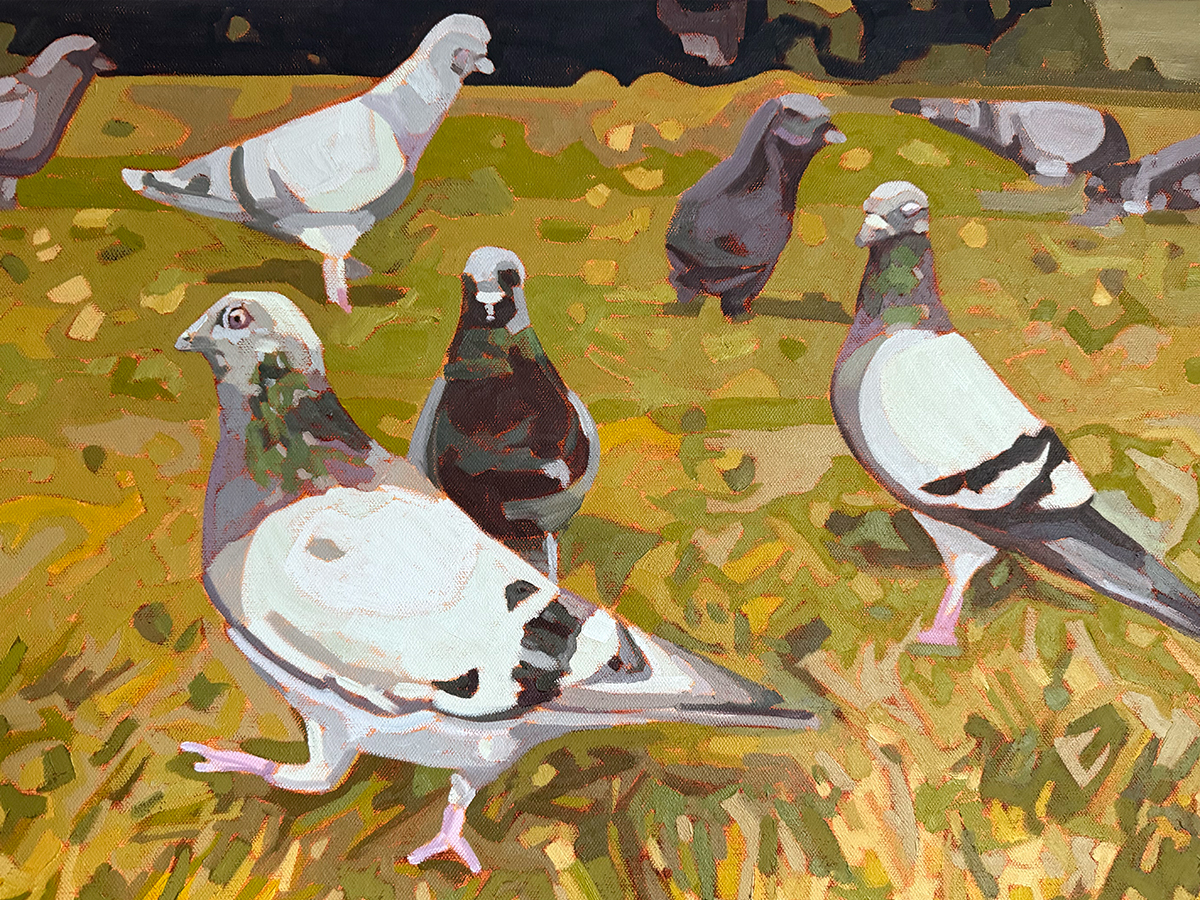
This 24×24″ oil painting of pigeons in a group is a bit of a departure and maybe a chance to show a different side of my work, and of me.
If you’ve been following my landscapes, you know I have a deep interest in using colour blocks to map out large expanses of space and distance. This painting uses the same language of colour facets, just applied to a less traditionally romantic subject. Pigeons, in a patch of grass, minding their own business. Or are they?

The composition is engineered to put you in it, not just as an observer. The pigeons occupy roughly the top half of the canvas. The grass, painted loose and expressive in the foreground and softening out of focus as it recedes, takes the bottom half. That bottom section is you. You’re at pigeon level, as close as you can get to a pigeon before it decides you’re too close.
One pigeon, dead centre, is almost making eye contact with you — though technically it isn’t. Pigeons don’t have forward-facing vision the way predators, and we, do. But it feels like you’re being stared down all the same. Around it, the rest of the flock goes about its business: one in sharper focus, keeping to itself; one that looks like it’s cautiously coming over to say hey; one giving side-eye from the back. A little community you’ve wandered into. You’re part of it, and also clearly not.
Are you observing as you or as a pigeon?
Pigeon fast fact:
Pigeons are feral descendants of the wild rock dove, which were domesticated thousands of years ago by humans and released into the wild.
If you didn’t already know that fact, does that change your perception of pigeons? Do you feel humans have a responsibility to care for these animals that we cast away? Or do you feel that pigeons are thriving without human interference? I think the way you answer will determine if you are observing as yourself in the painting or as a fellow pigeon.
Future work and questions left behind
In my artistic practice, I like exploring a feeling of nature being larger than ourselves. But pigeons complicate that feeling a little. They’re nature we made and then let loose. Maybe that’s the question I want to keep sitting with: not whether nature persists despite us, but what we owe the parts of it we’re tangled up in.
I’d like to explore these themes on a smaller scale, and with a little bit of humour, like these pigeons.
